


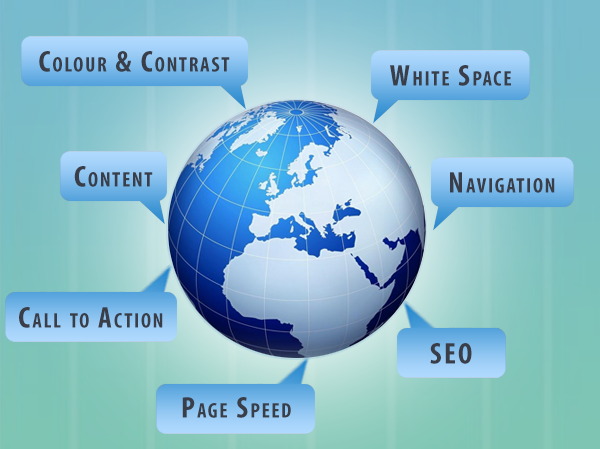
Whether your website is a small mom and pop store or a large corporation, good web design skills are an absolute must if you want to reach your target market. When creating your website, you need to remember that your site has to compete with a lot of websites that are on the Internet today. The best websites on the net are those that are easily understood, have engaging content and are easy to navigate.
Here are some tips to help you design your web pages with your visitors’ needs in mind.
1. Colour and Contrast
The colours should be pleasing and the same colour scheme should be used throughout the site. Don’t use a dark coloured font against a dark background as it will be difficult to read, same with light font on a light background. There should be a good contrast between the background and the font colour. You want them to read what’s on your site don’t you?
2. Navigation
Internet surfers have become quite used to seeing things in a particular way. Ensure that your site navigation is easy to recognize and familiar to use. Menus or navigation bars should be in the same place on every pages. Remember the 3 click rule. Visitors should never be more than 3 clicks away from the information they’re looking for.
3. White Space
White space is important for web design because it improves readability and focus. It is also referred to as ‘negative’ space. Keeping your site simple with white space will give your page breathing space instead of cramming it with content. Google uses white space effectively on it’s page. The only content on the page is the search section surrounded with white space on all sides so the focus is only on the search.
4. Content
People are in a hurry. They rarely read, they scan pages. Use attractive, easy to read fonts and simple language. Use short paragraphs, headers and bullets. When writing content, keep your tone friendly and conversational and your sentences short. People go to the internet to get information. If you can provide useful information on your site that is updated regularly, your visitors will keep coming back to your site!
5. Faster Loading Pages
Have you ever gone to a site and waited and waited and waited for the page to load? Make your web pages load faster by minimizing the number of graphics you use and by optimizing images. Another reason you need to have pages that load quickly is because Google has identified page speed as a search ranking factor. GTmetrix is great tool to test your website loading speed.
6. Search Engine Optimization
If you’re like most businesses who want to be found online in the search engine results, you will need to optimize your website for search engines.Before you start writing content for your site, you must first decide what keywords or phrases visitors are using for your niche. Once you have picked your keywords or phrases, add them in the content. Google Keyword Planner is a popular keyword tool to choose keywords.
7. Call to Action
Having a call to action (CTA) will encourage your visitors to take action. Asking visitors to buy something, request a quote or subscribe to your newsletter are examples of call to action. They are usually placed above the ‘fold’ (viewable area). For longer pages, it can be added at the bottom of the page too.
Summary
The page look and structure play an important role along with other elements in helping users find what they want quickly and easily. It improves the user experience and provides your users with content they can read and take action on.


